Leeks
Nutrition
| Serving Size | 85 grams |
|---|---|
| Calories | 50 |
| Daily Value | |
| Calories From Fat | 0 |
| Total Fat 0 | 0% |
| Saturated Fat 0 | 0% |
| Trans Fat 0 | 0% |
| Cholesterol 0 | 0% |
| Sodium 20mg | 1% |
| Total Carbohydrate 13g | 5% |
| Dietary Fiber 2g | 7% |
| Sugars 3g | 6% |
| Sugars Added 0g | 0% |
| Protein 1g | 2% |
| Calcium 50mg | 4% |
| Iron 1.8mg | 10% |
| Vitamin D 0mcg | 0% |
| Potassium 150mg | 3% |
Leeks are a good source of Vitamin K, iron, and folate, supporting healthy blood and helping reduce the risk of heart attack.
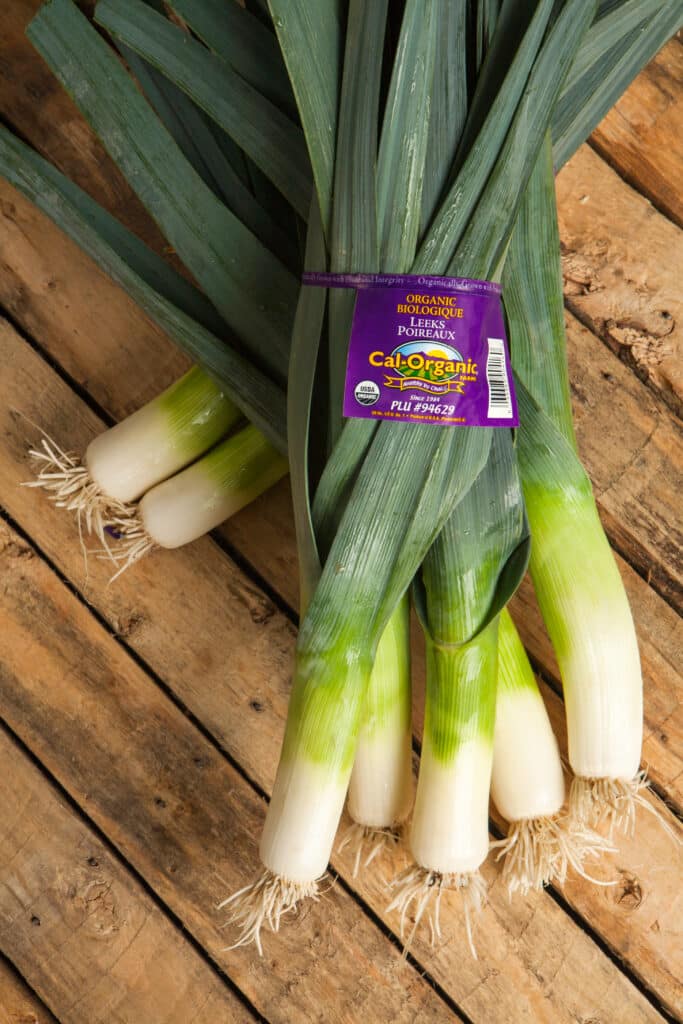
Like onions and garlic, leeks contain many flavonoids that assist in immune system and blood health. Leeks are also a good source of vitamins C, B6 and K, manganese, and iron. With its mild onion-like flavor, leeks work well in a variety of soups and other dishes. Try pairing them with potatoes!
Refrigerate leeks unwashed and untrimmed, wrapped loosely in a plastic bag. This will keep the leeks fresh for one to two weeks.
Cut off roots and green tops, then remove the outer layer. Rinse the leeks, then cut them in half lengthwise, and slice into small pieces.
Leeks perfectly compliment potatoes. You can roast them with vegetables, bake in a quiche, add to a salad, or puree for a creamy soup.
Leaks are mild and sweet with a subtle, onion-like flavor. They are crunchy when they are raw, but soft and silky when cooked.
Availability
- Jan
- Feb
- Mar
- Apr
- May
- Jun
- Jul
- Aug
- Sep
- Oct
- Nov
- Dec